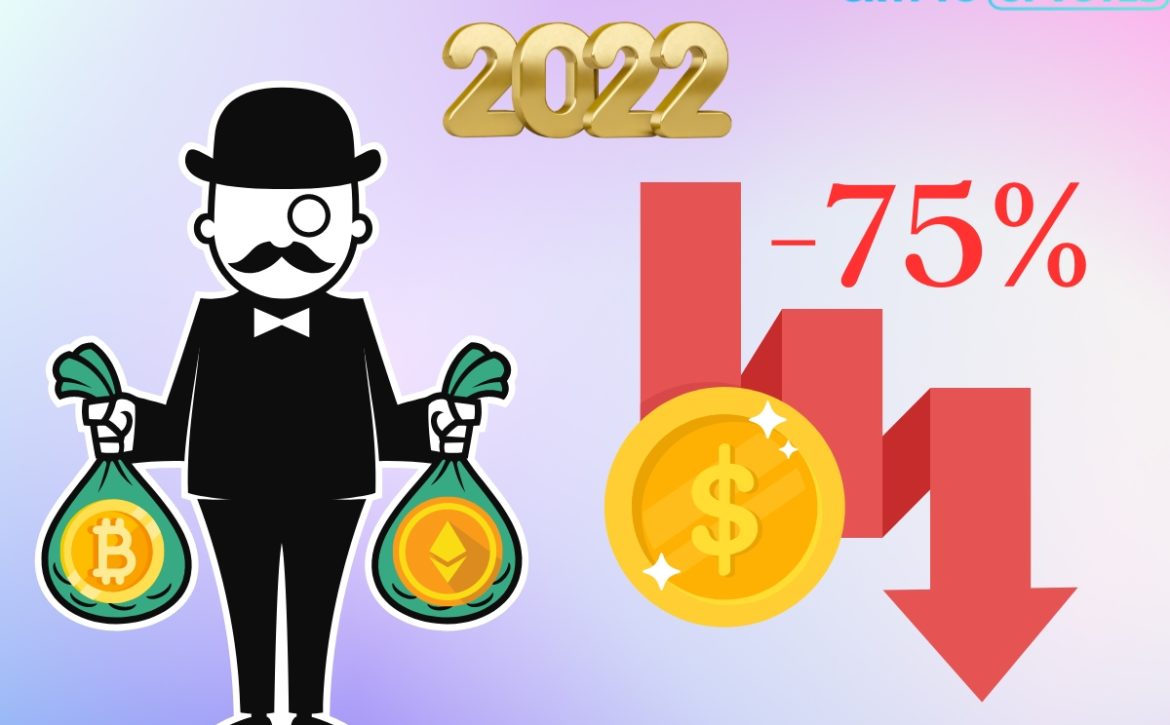
Crypto billionaires have lost 75% of their fortune in 2022

The capital of crypto billionaires for 12 months decreased by $ 110 billion. Review of Crypto Upvotes experts

The richest people in the cryptocurrency industry lost more than 75% of their capital in 2022. Forbes estimates that the combined fortune of crypto-billionaires has decreased by about $110 billion in 12 months.

Last year, the magazine counted 19 billionaires among cryptocurrency owners. At the same time, the total assets were estimated at about $140 billion. Lawsuits, bankruptcies and falling asset values during the “crypto winter” caused serious damage to the industry. Therefore, by March 10, 2023, the total capital of crypto billionaires decreased to $30 billion. And the title of a billionaire itself was retained by only nine people.

Rating of crypto billionaires

  • The head of the largest cryptocurrency exchange Binance, Changpeng Zhao, still occupies the first place in the ranking. His fortune last year was estimated at $65 billion. But now it is only $10.5 billion.
  • In second place is the co-founder of blockchain projects Stellar and Ripple. As well as the creator of one of the first crypto-exchanges MtGox Jed McCaleb with a capital of $2.4 billion ($2.5 billion a year earlier).
  • The third place ($2.2 billion) is shared by Coinbase CEO Brian Armstrong and Ripple chairman Chris Larsen. The former’s fortune last year was estimated at $6.6 billion, the latter at $4.3 billion.
  • Next up are the founders of Web3 infrastructure developer Alchemy, Nikhil Viswanathan and Joseph Lau. And they each have a fortune of $1.8 billion ($2.4 billion a year earlier).
  • The seventh and eighth places are held by the founders of the Gemini exchange, brothers Cameron and Tyler Winklevoss. Each of them owns $1.2 billion. A year earlier, the state of each of them was $4 billion.
  • The list of billionaires closes the cryptoinvestor Matthew Roszak with a capital of $1.1 billion. In March 2022, his fortune was estimated at $1.4 billion.

List of who is no longer a crypto billionaire

Out of the list of billionaires are Upbit exchange founder Son Chee Hyun, Paradigm and Coinbase co-founder Fred Ehrsam. As well as MicroStrategy founder Michael Saylor (now valued at $760 million), venture capital investor Tim Draper. Also out are Devin Finzer and Alex Atalla, who founded the NFT marketplace OpenSea. And Barry Silbert, head of Digital Currency Group (his fortune dropped from $3.2 billion to $320 million).

Our experts note that Sam Bankman-Fried and Gary Wang of FTX were the hardest hit. Bankman-Fried last year ranked second with a capital of $ 24 billion. And now his fortune Forbes estimates less than $ 10 million. Experts estimate the state Wang the same amount, a year earlier it was $ 5.9 billion.

Read More

Whales may have known in advance about the Dogecoin growth

Using onchain metrics, Santiment analysts analyzed recent developments and actions of Whales in the cryptocurrency meme.

Santiment analysts have suggested that Whale is aware of the recent rise of Dogecoin (DOGE). Exploring onchain metrics, they analyzed the movement of the coin’s exchange rate. As well as the actions of its owners.

On April 3, Elon Musk swapped the Twitter logo for the Dogecoin symbol. According to analysts, most of the cryptocurrency community already knows. That if Musk does something on social media, his goal is to have fun, get attention or make money. Perhaps in this case, all three goals were met, Santiment noted.

The day after Twitter’s logo change, the Dogecoin token rate soared more than 33%, temporarily outpacing the growth of other cryptocurrencies. This happened in two waves: the big price jump started and ended almost immediately after the news (from $0.077 to $0.100), followed by the second wave of growth (to $0.102).

Studying transaction data and market indicators, Santiment analysts noted many signals. Which indicated when the big players (who, according to the authors, probably knew about the planned “pumping” of DOGE) were exiting the asset. Or at least recorded large profits.

Santiment explained that when the number of active addresses. As well as the volume of trades and transactions, and transactions of “whales” (addresses with more than $100k) together increase sharply in the period. And when an asset experiences growth independent of other markets, it is possible to assert with confidence. That here almost always forms a local top and fixation of profit at this moment.

Four types of DOGE holders

Analysts have studied the behavior of coin owners, dividing them into four categories based on the number of Dogecoin tokens:

“Fishes” (0-10 DOGE);
“Dolphins” (10 to 10 thousand DOGE);
“Sharks” (10 thousand to 10 million DOGE);
“Whales” (10 million or more DOGE).

According to the study, “fishy” addresses aggressively bought the coin the moment the price peaked. This is typical and is one of the signs of a price peak. “Dolphins” and “sharks” showed no signs of participating in this rally.

Our experts note that “Whales” were buying small quantities of the token in anticipation of replacing the Twitter logo. And as soon as the Dogecoin price jumped, the owners of such wallets fixed their profits.

Santiment suggests that something might have been known to the big DOGE holders. This is just a guess – the identities of address holders are unknown.

Read More

Coinbase upheld lawsuit against Tornado Cash cryptomixer ban

A group of plaintiffs in a case to lift sanctions imposed by U.S. authorities on cryptomixer Tornado Cash has filed a motion for summary judgment

Cryptocurrency exchange Coinbase has upheld a lawsuit against the Tornado Cash cryptomixer ban. On April 5, a group of individuals filed a motion for summary judgment in the case against the U.S. Treasury Department to lift sanctions on the cryptocurrency protocol.

On August 8, the U.S. Treasury Department imposed sanctions against Tornado Cash. The agency’s OFAC division put the cryptocurrency protocol and related digital wallet addresses on the sanctions list (SDN). According to U.S. authorities, more than $7 billion in illicit cryptocurrency proceeds have been laundered through this mixing service since its inception in 2019.

In September, 6 people, including Coinbase exchange representatives Tyler Almeida and Nate Welch, appealed OFAC decision. In their view, the agency exceeded its authority. And its actions violate the first amendment of the U.S. Constitution on freedom of speech. The defendants in the suit are the U.S. Treasury Department, its head Janet Yellen, OFAC and its head Andrea Gaki.

Coinbase General Counsel Paul Grewal wrote that the plaintiffs filed a motion for summary judgment in part. In which they asked the court to “open Tornado Cash to all.” If the motion is granted, the judge will rule on some of the factual issues, leaving others for trial.

Grewal noted that the citizens who appealed “are among the thousands of law-abiding Americans Who want to protect their privacy but cannot do so because of government sanctions.”

A Coinbase lawyer recalled the plaintiffs’ arguments. They argue that the government cannot sanction Tornado Cash. That’s because it’s not a forehttps://crypto-upvotes.com/coinbase-upheld-…-cryptomixer-ban/ign national or legal entity, it’s software. He also noted that the government can only legally sanction property, which the Tornado Cash code is not.

Our experts note that the rate of the token Tronado Cash (TORN) rose 14% after the news of the petition. The cryptocurrency’s value rose from $6.95 to $7.95

Read More

Trading volume on DEX has reached a maximum in 10 months

The growth of traders’ activity on DEX platforms in March is one and a half times higher than in February. This comes after the bankruptcy of U.S. banks and regulatory pressure on centralized cryptocurrency exchanges.

Trading volume on decentralized exchanges (DEX) reached a ten-month high. For the first time since May 2022, according to DeFiLlama, the figure rose to $133.3 billion in March, up 53% from $86.9 billion in February.

Trading volumes on decentralized exchanges topped $145 billion in May 2022, following the collapse of TerraUSD (UST) and Luna tokens. And then declined to $65 billion in October. The bankruptcy of the FTX exchange again caused an increase in trading volume on DEX – in November it was $113 billion. And then again for three months did not rise above $87 billion.

A surge in cryptocurrency trading on DEX platforms began in March after Silvergate Bank announced it was shutting down operations. For example, in the week following the news of the bank’s problems alone, trading volume on DEX was $50.2 billion, which was also the highest since the Terraform Labs token crash.

This was followed by the collapse of Signature Bank as well as a warning from the SEC to Coinbase. And the Commodity Futures Trading Commission (CFTC) lawsuit against Binance. At the end of a difficult month for the cryptocurrency industry, trading volume on DEX exceeded $133 billion.

Our experts note that Curve ($4.78 billion), Uniswap ($4.06 billion) and PancakeSwap ($2.33 billion) are leaders among decentralized exchanges in terms of total value locked (TVL).

Read More

Capitalization of leading gold stablecoins exceeded $1 billion

Stablecoins supporting precious metal parity rise in price as gold price nears record highs

The market capitalization of stablecoins, which are linked to the price of gold, has surpassed $1 billion. The price of tokens is rising along with the value of the underlying asset.

May gold futures rose 1.91% to $2029.4 an ounce on the New York Mercantile Exchange (COMEX) on Tuesday, April 4. This is the highest since March 2022. On Wednesday, April 5, the price of gold continued to rise. In the moment, its price on COMEX increased by 0.12%, to $2032 per ounce.

Gold reached historical highs of $2088 per ounce for COMEX standard futures contract on March 9, 2022.

According to our experts, demand for gold increased amid a weakening dollar in the international market. And the uncertainty of investors in the “bright prospects” of the global economy.

The two largest “gold” stablecoins are PAX Gold (PAXG) from U.S. fintech company Paxos Trust and Tether Gold (XAUT) from Tether. According to CoinGecko, the market capitalization of PAXG rose to $523 million and XAUT to $499 million on April 5. On April 4, those figures were at $509 million and $488 million, respectively.

During the day the value of PAXG grew by 2% to $2035.50. And XAUT rose 2.1%, to $2033.46. Over the past 30 days, Tether Gold has gained 9.2% and PAX Gold has gained 10.4%.

Bitcoin’s correlation with gold hit a multi-year high at the end of March, according to analytics platform Kaiko. It was 50% and surpassed the correlation of BTC with U.S. stocks.

Read More

Large Swiss bank will open 2.5 million customers to cryptocurrencies

PostFinance, Swiss national postal service’s bank division, will give customers access to buy, hold and sell Bitcoin and Ethereum

PostFinance, the Swiss post office bank, will partner with Sygnum Bank, a Swiss digital asset bank, to open up cryptocurrency transactions to more than 2.5 million customers. The cryptobank said in an announcement that PostFinance customers will be able to buy, store and sell cryptocurrencies such as bitcoin and Ethereum.

PostFinance is one of Switzerland’s largest retail banks. It is wholly owned by the Swiss Post, which in turn is owned by the state. According to the bank’s website, more than 2.5 million people use its services.

Bank Sygnum is licensed as a provider of cryptocurrency services in Switzerland. And it serves a range of institutions, including cantonal and private banks. PostFinance is integrating Sygnum’s b2b platform into its infrastructure.

According to the report, PostFinance has analyzed the investment needs of its customers. And it identified a high demand for digital investment services.

“Digital assets have become an integral part of the financial world. And our clients want access to this marketplace at PostFinance,” said PostFinance Chief Investment Officer Philip Merkt.

PostFinance’s decision to switch to cryptocurrency was driven in part by an outflow of funds from Swiss retail banks into the digital asset class.

PostFinance has noted a multi-million dollar outflow of funds to cryptocurrency exchanges in recent years. So not only did the bank see an opportunity to generate new revenue in its work with digital assets. But it also realized that it made a big difference in retaining existing customers.

Our experts note that in addition to Bitcoin and Ethereum, PostFinance will later add other cryptocurrencies.

Read More

Investment firms show extraordinary interest in cryptocurrency ETF

Despite last year’s 48% drop in cryptocurrency prices. Brown Brothers Harriman survey participants plan to add digital asset ETF to their portfolios this year

According to a survey conducted by Brown Brothers Harriman (BBH), 74% of institutional investors. The survey resulted in an “extraordinary” or heightened interest in cryptocurrency ETF.

On April 3, BBH released the results of its 2023 Global ETF Investor Servey. The survey surveyed 325 institutional investors, financial advisors and fund managers from the U.S., Europe and China.

According to the report, despite last year’s drop in cryptocurrency prices. In it, a quarter of respondents intend to devote more money to investing in ETF for digital assets. Institutional investors showed the greatest interest, with nearly three-quarters extremely interested in adding cryptocurrency ETF to their portfolios.

Our experts note that this year, 48% of survey participants plan to do so: 58% of investors from China, 55% – from the United States and only 29% – from Europe.

The report explains that the growing interest in cryptocurrency ETFs is partly due to investors adjusting to market volatility. As well as diversifying portfolios and adding more innovative products. And regulatory initiatives such as the MiCA (Markets in Crypto Assets) project of the European Union. It can significantly “reduce the risk” of cryptocurrency investments for asset managers. And provide them “an additional level of comfort” when working with crypto exchanges.

Read More

Sales of Donald Trump NFT up 90% on news of his arrest

A NFT, which was priced at $99 after release, sells in the $700 to $1,400 range.

Donald Trump’s arrest triggered a burst of interest in his NFT. Trading volume of digital tokens from the former U.S. president increased by 89.8% overnight, according to CryptoSlam.

On the evening of April 4, Trump was arrested pending arraignment the same evening. He was charged with 34 episodes, including falsifying business records. The 45th U.S. president himself considered what was happening to be “political harassment and election interference at the highest level in history” by Democrats. He did not admit guilt.

Trump issued a collection of 45,000 NFTs on the Polygon blockchain last December 15. The tokens represent images of him in the form of collectible baseball cards. There were 44,000 NFTs for sale at $99 apiece. All tokens were sold out in the first 24 hours, primary sales brought the project almost $4.4 million.

On April 3, token sales totaled $22,600, but NFT was sold for $70,300 on April 4. During the last day, 78 tokens were sold at prices ranging from $700 to $1,400.

Our experts note that despite a short-term increase in interest in Trump’s NFT collection against the backdrop of the trial. His NFT sales this past March were down from previous months. Thus, in March the volume of trading was $2 million, in February – $4 million, in January – $2.6 million. And for the half of December, when the collection was released – $9.9 million.


Read More

LayerZero crypto protocol raised $120 million at $3 billion valuation

LayerZero is a project whose solutions use the leading DeFi protocols for conducting cross network transactions. It will spend funds to promote in Asia and add to the team

Crypto protocol developer LayerZero has raised $120 million at a valuation of $3 billion, The Block reports. LayerZero Labs developers have closed a Series B funding round. Thirty-three investors participated in this funding round, including a16z Crypto (Andreessen Horowitz), Sequoia Capital, Circle Ventures, Samsung Next, OpenSea and Christie’s.

LayerZero is a protocol for exchanging data between blockchains from different ecosystems. The Series A funding round for the project took place in March 2022. At the time, LayerZero raised $135 million at a valuation of $1 billion.

Leading DeFi protocols such as Uniswap, SushiSwap and PancakeSwap use LayerZero for cross-network transactions. LayerZero Labs co-founder and CEO Brian Pellegrino said. That the company now plans to expand its cooperation with gaming projects and for this purpose will increase the number of employees from 40 to 70.

Also the company will direct the received funds to expand its presence in the Asia Pacific region.

LayerZero is also one of the potential contenders for the release and distribution of their own tokens. The project is often mentioned in topical discussions of possible airdrops on social networks. Commenting on the fundraising, Pellegrino declined to say when his token would launch.

Other Perspective Projects that have not yet launched their token

Our experts note that earlier this spring hardware wallet maker Ledger reported raising funds from investors. As well as the development-oriented artificial intelligence (AI) crypto project Fetch.ai.

Ledger has raised the bulk of the planned €100 million at a valuation of €1.3 billion, and intends to continue fundraising in April. The company will use the money raised to develop its business and expand its distribution network. As well as increasing production and improving its products.

Fetch.ai has received $40 million from the investor, which will be spent on blockchain infrastructure development. It will also be used to create and deploy automated applications using artificial intelligence.

Also on April 4, it became known that Dragonfly Capital invested $10 million in the cryptocurrency derivatives exchange Bitget. The platform will spend them on the development of spot trading, the creation of new profitable products. As well as supporting startups and attracting new users to cryptocurrency industry.

According to CoinGecko, Bitget ranks fifth among derivatives exchanges in terms of open interest (OI) and trading volume. At the same time, the Japanese regulator in March issued a warning to the site for working with Japanese residents without proper registration.


Read More

How decentralized crypto exchanges depend on the SEC

A wave of repression by U.S. exchange regulators is affecting the companies behind development of decentralized crypto exchanges. Review by Crypto Upvotes experts

The cryptocurrency exchange dYdX, one of the most popular DeFi trading platforms. It is on its way to becoming a fully decentralized project, not the least of which is the policy of the U.S. government. Right now it’s running on a hybrid decentralized model. But in September, developers plan to launch a new version of it. This should help reduce the influence of centralized structures, on which it still has to rely.

The exchange depends at least on the dYdX Trading behind its development and StarkWare’s solutions for scaling trading capabilities on the Ethereum network. In the new version, dYdX will run on the Cosmos blockchain and leverage its own protocols. This is to minimize reliance on centralized links, any of which could potentially be pressured by regulators.

Decentralized finance (DeFi) projects are characterized by the absence of intermediaries for trading or loan transactions in crypto-assets. An automated protocol, the smart contract, plays the role of an intermediary. However, as in the case of dYdX, the development of this protocol is the responsibility of a specific company and team of developers.

Most DeFi projects issue their own tokens, which are traded on cryptocurrency exchanges. After the head of the U.S. SEC Gary Gensler said. that almost all existing crypto-assets are considered securities by the agency, any token issuer potentially falls under the agency’s oversight.

Repressions from the SEC of epic proportions

Speaking to community members during a conference call on March 30. The head of another decentralized exchange, SushiSwap, Jared Gray. Said he “stopped getting inspired” by his work. Gray spoke candidly about his attitude towards American regulators. In particular, he mentioned Senator Elizabeth Warren’s campaign platform, which included a total ban on cryptocurrency transactions in the United States. Politico published an article about Warren, saying in the headline that she was “raising an army against cryptocurrencies.

The week before, Gray revealed that he had received a subpoena from the SEC regarding his involvement with SushiSwap. To fund the impending lawsuit, Gray brought a proposal to the exchange’s existing Decentralized Autonomous Organization (DAO). In it, he proposed setting aside $4 million from the Treasury of the Record to create a “Sushi DAO Legal Defense Fund.”

“This is about an onslaught and retaliation of epic proportions, and it’s only going to get worse,” warned former SEC official John Reed Stark in a commentary for Bloomberg. Stark served as a senior adviser to the agency. And headed the Internet enforcement offices. He observed that regulators initially left market leaders untouched, focusing on easy-to-access projects. But now they’re targeting the big players as well.

What’s already happened this year

Also earlier this year, the SEC sued the cryptocurrency exchange Gemini because its Earn. Which allows users of the site to earn interest from lending their tokens. The service then fined Kraken exchange $30 million, while equating its stacking service with making money from unregistered securities. Later, the agency banned Paxos from issuing the BUSD token. It was second only to Tether’s USDC and Circle’s USDC in terms of capitalization.

In late March, the SEC accused Tron blockchain founder and Huobi exchange co-owner Justin Sun of artificially inflating trading volumes on the exchange. Just the same day, Coinbase received a notice from the SEC. It threatened to sue over a number of tokens and financial products available on this platform.

Full decentralization is needed to save crypto exchanges

Decentralized exchanges are already passing Coinbase in terms of trading volumes. Uniswap reached $71.6 billion in March, according to The Block Research. This is 45% higher than Coinbase’s $49.4 billion in the same month. Among traditional crypto exchanges, Coinbase is second only to Binance in terms of volume.

Summing up the results of the first quarter of this year Coinbase representatives wrote. That the trends on the exchange reflect a larger market. The actions of the SEC and CFTC only underscore the uncertainty surrounding Ethereum and other altcoins.

Referring to the Coinbase situation, in an interview with Bloomberg, dYdX head Antonio Giuliano says. About more and more cryptocompanies refusing to actively engage with regulators in the U.S. against the backdrop of what is happening. His company, dYdX Trading, will continue to work on the protocol after the launch of the new version of the exchange.

According to Giuliano, the network on which the next version of dYdX will run will work with multiple transaction validators. This is to minimize the risks of being banned or censored, to which the centralized mechanism is subject. The exchange will not technically have the ability to reject or censor transactions.

Our experts believe that the final form for everything in DeFi should be complete decentralization !

Read More